Holistic Music Education with Learnmusic.eu
Learning Music as a Lifelong Craft: Why Composition and Performance Belong Together
Music education, and piano lessons in London and worldwide today is increasingly moving away from rigid, exam-only pathways toward something more holistic: lifelong musicianship. Learners—children and adults alike—are no longer satisfied with reproducing repertoire alone. They want to understand music as a language, a craft, and a living cultural practice.
One of the most effective ways to achieve this is by reconnecting performance and composition, disciplines that historically were never meant to be separated.
Many of the great composers—Bach, Mozart, Beethoven—were also performers and teachers. Their music was inseparable from the physical realities of the instrument and the pedagogical needs of their students. Modern education, however, often fragments these roles, leaving learners fluent in execution but disconnected from meaning.
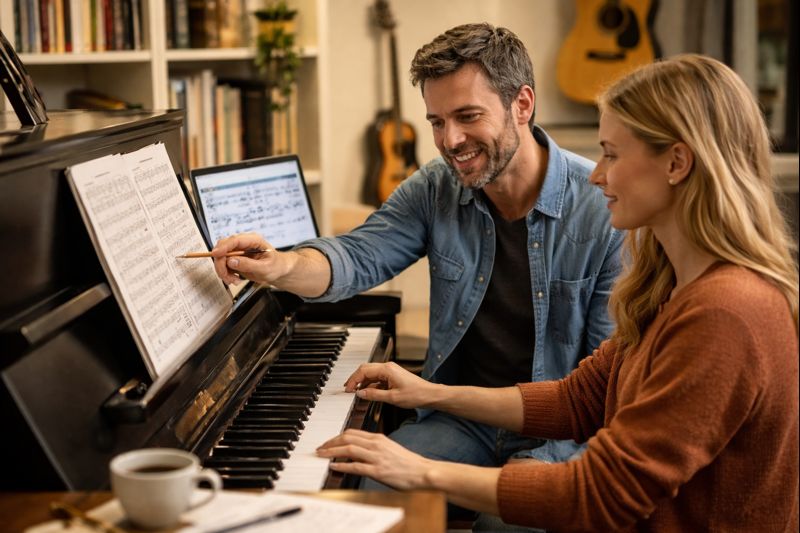
Integrating compositional thinking into instrumental study changes how students learn. Rhythm becomes intentional. Harmony becomes audible rather than abstract. Form becomes something felt rather than memorised.
This approach is particularly valuable in online and international learning environments, where students come from diverse musical backgrounds and learning cultures. A unified framework—one that explains how music is constructed and embodied—provides common ground.
Platforms like ours exemplify this integrated philosophy. Instead of treating composition as an elite or separate pursuit, it is used as a tool to deepen performance, interpretation, and musical autonomy.
For learners, the benefits are tangible. Sight-reading improves because patterns are recognised. Memorisation becomes logical rather than fragile. Interpretation becomes personal rather than imitative.
From an educational standpoint, this also supports long-term engagement. Students who understand music structurally are less likely to plateau or abandon study when technical progress slows. They possess intellectual ownership of the material.
In an era where music learning increasingly happens across borders and platforms, pedagogy must be robust enough to travel. Composition-informed teaching does exactly that: it equips learners with transferable musical intelligence rather than isolated tricks.
Learning music, ultimately, is not about passing through grades. It is about acquiring a way of thinking—one that remains relevant whether one plays in an orchestra, composes privately, teaches others, or simply listens more deeply.